by James Antonius Fulk
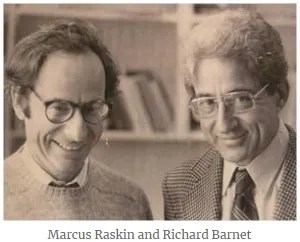
On December 29, 2017, The Times of Israel reported that Milwaukee born Marcus Raskin (J.D. in 1957), the son of Russian Jewish immigrants and co-founder of the “progressive Institute for Policy Studies [IPS], died on December 24th in his Washington, DC home” at 83 years of age.1 Marcus was survived by his four children one of which was Jaime Raskin who is currently serving as a Democrat in the U.S. House of Representatives.2 Jaime’s wife is Sarah Bloom Raskin who is a current Council on Foreign Relations (CFR) member and former United States Deputy Secretary of the Treasury under former President Barack Obama.3‘4
The other co-founder for the Institute for Policy Studies (IPS) was Boston born Richard Barnet (J.D in 1954) who died in 2004.5 Barnet was also a CFR member elected to membership in 1969.6
On the IPS website history page, their origin story is explained in the following passage:7
The story of IPS began at a high-powered State Department meeting of generals and defense industry executives in 1961, at the height of the Cold War. In the room were White House staffer Marcus Raskin and State Department lawyer Richard Barnet, who had joined the Kennedy Administration with hopes of systemic transformation. But after hearing the speeches and rhetoric of the officials that day, the two young public servants concluded that systemic change can only happen through the power social movements. Within two years, Raskin and Barnet had left the Kennedy Administration and founded the Institute for Policy Studies, where they could more freely ‘speak truth to power.’
In declassified FBI files, the FBI mentions that IPS had its genesis in the Peace Research Institute. That outfit was led by American born rabbi Dr. Arthur Waskow who was a contributing editor to Ramparts magazine. Waskow merged with IPS in 1963 becoming a senior fellow there.8
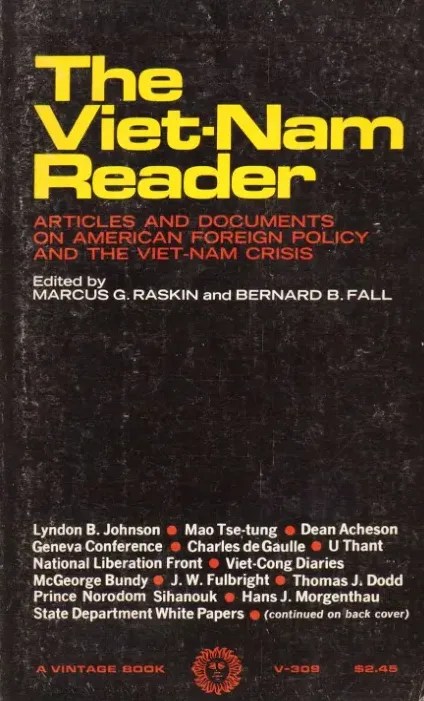
The IPS history page goes on to say that “As soon as IPS opened its doors in 1963, it plunged into the anti-Vietnam War movement. In 1965, Raskin and associate fellow of IPS Dr. Bernard Fall edited The Vietnam Reader—a textbook for teach-ins across the country.”9 Bernard was an Austrian-born, Jewish, French immigrant who escaped the Nazi roundups in France as a teen and later fought in the French resistance against the Nazi occupation. Later in life, Bernard would make many trips to Indo China which influenced his position on the Vietnam War.10
The origin of the idea for the teach ins was credited to Dr. Marshall D. Sahlins of the University of Michigan according to a New York Times article.11 Sahlins was an American anthropologist and son of Russian (Ukrainian region) Jewish immigrants. His mother, as a child, was said to have distributed Russian revolutionary leaflets.12 The idea for the teach-ins came to Sahlins when he and his colleagues got together in his living room in 1965 to discuss what they could do to “oppose President Lyndon B. Johnson’s escalation of the war.”13
Sahlins said, what if they took “a page from the sit-in protests of the civil rights movement, what if they set aside their syllabuses and gave lectures about America’s foreign policy, politics and history?”14 In May of 1965, Sahlins then led a national teach-in in Washington that got worldwide coverage.15 Sahlins might have been in contact with Raskin and or Barnet at that time; however, I haven’t found sources to confirm this connection at the time of writing this article. What is confirmed is that all three of their names—Raskin, Barnet and Sahlins—show up on a Students for a Democratic Society (SDS) National Vietnam Examination Pamphlet which also directs readers to the Vietnam Reader of Raskin and Bernard Fall for further education.16

Funding in the early days of IPS came from multiple donors which I will summarize below referencing the work of Brian Scott Mueller on this subject:17
- Budget for 1963-1964 was $200,000. $40,000 from Edgar Stern Foundation. $32,500 from Peace Research Institute. $50,000 from anonymous donor.
- By March 1964, IPS received $167,577.74. Large grants came from the Stern Family Fund, the Ford Foundation, the EDO Foundation and James Warburg.
- 1967 Warburg donated $400,000 to IPS. $25,000 was donate by the Samuel Rubin Foundation. Smaller donations came from Phillip Stern and Irving Laucks of the Center for the Study of Democratic Institutions.
- 1968 Philip Sterns gave IPS over $91,000. The Sterns Family Fund gave $11,000. Samuel Rubin Foundation donated $30,000 and the D.J. Bernstein Foundation donated $50,000. Other smaller contributions came from the Carnegie Corporation and the Field Foundation.
- 1972 IPS received $1,066,350 in assets from the estate of Daniel J. Bernstein.
- 1974-75 the Samuel Rubin Foundation gave IPS over $300,000. $255,000 of that donation went towards the creation of the Transnational Institute (TNI).
Of the donors above, it was Samuel Rubin’s (Rubin was a suspected CPUSA member) that was largely earmarked for the Transnational Institute. According to a Transnational Institute (TNI) article, Cora Weiss, the daughter of Samuel Rubin, set up the Samuel Rubin Foundation and ensured that TNI remained funded.18‘19 Rubin previously gave “$500,000 a year until his death in 1982” to TNI. I previously mentioned that TNI was initially funded by Rubin in 1974-75, according to Brian Scott Mueller’s research, where it received $255,000 from a $300,000 donation to IPS. Furthermore, U.S. Representative Larry McDonald stated that in 1974, TNI received $1.2 million from the Samuel Rubin Foundation.20
In the Swarthmore College Peace Collection under the entry for the papers on Cora Weiss, she was described as:21
a peace and social justice leader and activist. She is a supporter of the United Nations, an early member of Women Strike for Peace, a leader in the anti-Vietnam war movement in the United States. In the 1970s Weiss was the director of the Riverside Church (New York, NY) Disarmament Program. Weiss was also active with SANE, SANE/Freeze, Peace Action, and The Hague Appeal for Peace. Weiss became president of the International Peace Bureau in 2000. She has always been active in women’s peace issues, hosting the first women’s radio program in New York City in the 1970s, attending women’s disarmament summits in the former Soviet Union, the U.N. Conference on Women in Beijing in 1995, and many other events. Weiss is the recipient of numerous peace awards from all over the world.
Cora’s membership in the group Women Strike for Peace (WSP) places her in a group that was an affiliate of Soviet controlled Women’s International Democratic Federation. WSP was described in a Congressional Study as “‘a pro-Hanoi organization’ which from its inception ‘has enjoyed the complete support of the Communist Party.’” This is according to Kenneth DeGraffenreid’s congressional record. DeGraffenreid, at the time, was chairman of the subcommittee on Security and Terrorism of the U.S. Senate.22 Women’s Strike for Peace was also mentioned in a House of Representatives Staff Study as being infiltrated by the CPUSA.23
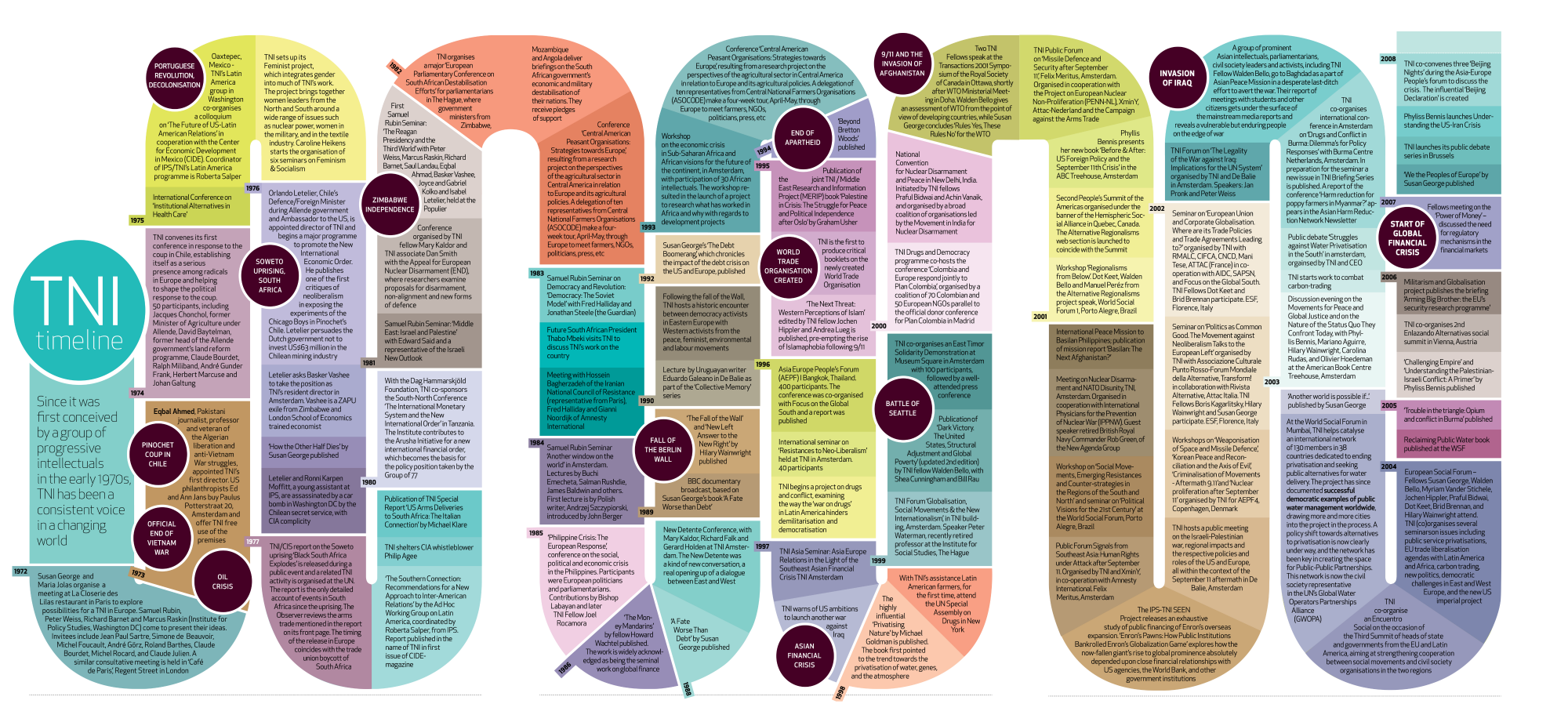
Circling back to TNI, it originated out of meetings in 1972. Quoting the TNI website:24
Susan George and Maria Jolas organize a meeting at La Closerie des Lilas restaurant in Paris to explore possibilities for a TNI in Europe. Samuel Rubin, Peter Weiss [Cora’s husband], Richard Barnet and Marcus Raskin come to present ideas.
One of the first fellows of IPS was also selected to be TNI’s first director—a Indian born Muslim man named Eqbal Ahmad.
Ahmad was born in Gaya, Bihar, British India in 1933 and migrated to Pakistan on foot in 1947 after the partition of India.25 Shortly after the partition, Ahmad volunteered for a battalion of the Muslim League Youth in the first Indo-Pakistani war of 1947-1948.26 The group Ahmad joined up with brought him to Muzaffarabad where he then decided to join a Communist Party unit led by Latif Afghani who was a communist activist, trade union leader and former member of the All India Students Federation of the Communist Party of India (AISF).27 An Interesting aside about AISF is that it is affiliated with the World Federation of Democratic Youth (WFDY) the organizing group of the 19th World Festival of Youth and Students in Sochi (their first general secretary was Alexander Shelepin), Russia which was attended by WFDY communist and socialist affiliates. Putin delivered a speech at this event which highlights the continuity of communism from the Soviet to post-Soviet world.28
In 1957, Ahmad came to the United States after graduating from college in Lahore, and he briefly served as an army officer. Ahmad ended up at Princeton in 1958.29 From 1960 to 1963 he lived in North Africa (primarily Algeria) joining the National Liberation Front while working with WW2 veteran Dr. Frantz Fanon who was described as the “Marx of the Third World” (he was of French-Afro-Caribbean descent).30‘31 Part of Ahmad’s work during this time was serving as a member of the Algerian Revolutionary Council researching the script for the “Battle of Algiers, the classic film of the revolution.”32
After his stint in Algeria, Ahmad returned stateside, earning his PhD in 1965, and in 1968 he made an interesting speech at an anti-war sit-in where he explained that when he had gone to the site of the Haymarket Riot of 1886 to lay flowers in respect for the protesters, he instead found a monument to the police officer that had helped maintain law and order there. Shortly thereafter, the FBI showed up at his residence and informed him the Weathermen (a radical SDS offshoot of which Eric Mann was also a member—Mann’s organization NCLC trained BLM leadership) had blown up the statue.33‘34
Sometime after 1968, Ahmad had joined an intellectual circle of the communist Mazdoor Kisan Party of Pakistan as reported by Raza Naeem of the Friday Times:35
Then after formally joining the then-Communist Mazdoor Kisan Party (CMKP), I often heard of a ‘Professors Group’ within the Mazdoor Kisan Party (MKP) – the older incarnation of the CMKP – comprising ‘professors’ who had mostly built their reputations abroad: Feroze Ahmad, Eqbal Ahmad, Hamza Alavi and Aijaz Ahmad and had joined the party in order to conduct Marxist study circles for the workers.
Beginning in 1972 Ahmad was made senior fellow at the Institute for Policy Studies—a position he would hold to 1982.36 In 1973, he was made director of the Transnational Institute, the organization started by IPS with heavy funding from Samuel Rubin (a suspected CPUSA member).37
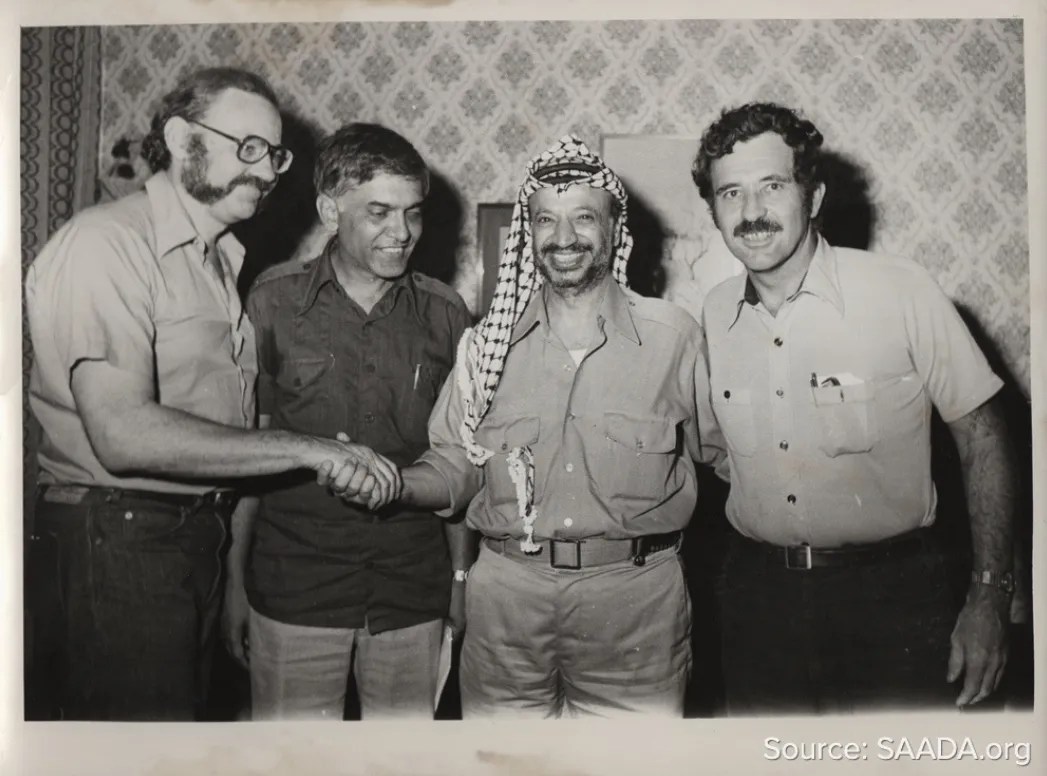
Ahmad was said to have “remained a committed Marxist throughout his life…”38 The Nation, reporting on Ahmad’s life remarked that he even travelled to Highgate Cemetery in London to pay his respects to Karl Marx.39
TNI’s first conference in 1974 established it “as a serious presence among radicals in Europe…”40 It featured guests such as: Chileans Jacque Chonchol and David Baytelman Goldberg (the latter the son of Ukrainian and Russian Jewish immigrants) both of whom were in the Marxist Allende Government; Belgian born, WW2 British navy veteran, Marxist Dr. Ralph Milibrand (son of Polish-Jewish immigrants);41 former French resistance movement member Claude Bordet; German-American sociologist Dr. Andre Gunder Frank (Gunder fled Germany during the Nazi era with his family because of his Jewish ancestry) who published works on such topics as “Is Real World Socialism Possible?” and participated in the socialist “reforms” of the Allende government;42 German-American-Jewish Marxist Scholar and former WW2 OSS officer Dr. Herbert Marcuse;43 and Norwegian Sociologist Dr. Johan Galtung (as a youngster he lived in Nazi occupied Norway).44
As evidenced by this first conference, there was heavy socialist and Marxist influence present. This was during the Cold War, a time when promoting Marxism and communism was tantamount in many peoples’ minds to siding with the enemy. TNI went as far as promoting Allende’s former socialist Defense and Foreign Minister Orlando Letelier as director of TNI. Letelier was recruited to TNI by Dr. Saul Landau an American-born (his father was a Ukrainian immigrant) filmmaker, and IPS fellow.45‘46
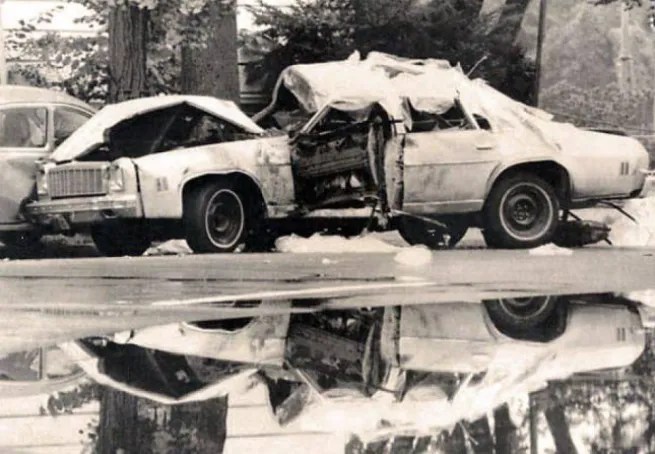
Letelier was assassinated in 1976 as director of TNI in a car bomb attack that killed him and an associate.47 While this event, rightly, sparked outrage and much of that was directed at Pinochet in Chile, what was ignored, as reported in the Washington Weekly (1980) by Reed Irvine, is that documents were recovered from the car bomb attack which indicated Letelier was working with Cuban intelligence. Some of the papers were leaked to the press in 1976, but Irvine acquired all of them from the FBI a few years later in a FOIA request.
Quoting Irvine’s article on this subject at length:48
Letelier was working closely with Cuban intelligence and that he had ties to both the East Germans and the Soviets. He was being paid regularly from Havana, and he was very anxious to keep the Cuban connection secret, knowing that its exposure would impair his effectiveness. In one letter to his paymaster, the Chilean wife of a high ranking Cuban intelligence officer, Letelier boasted of his “apparatus” in the United States. He had persuaded a number of prestigious Americans to serve as a facade. Letelier warned that care should be taken to keep the Cuban connection secret. He feared any hint of that would cause some of his liberal sponsors to resign. “You know how these ‘liberals’ are,” he wrote.
The evidence in the files indicates that Julian Rizo, Castro’s top spy in the U.S., was Letelier’s “control.” Rizo was stationed at the UN in 1975. He is now ambassador to Castro’s client state, Grenade. He and Letelier were in frequent contact. Letelier was also in touch with another top Cuban intelligence agent, Teofilo Acosta. His address book contained home and office phone numbers for the Cuban foreign minister and the head of the Cuban Communist Party, Carlos Rafael Rodriguez. The address book also shows that Letelier had excellent journalist contacts in the U.S., especially at the Washington Post.
Landau who recruited Letelier was a former member of the Communist Party’s Labor Youth League at the University of Wisconsin,49 SDS member, he participated in a group called “Joe Must Go Club” that was for recalling Senator Joseph McCarthy, he traveled to the Soviet Union and Cuba, and he made a documentary on Cuba which was viewed favorably by Castro and earned him an invite to come back and meet Castro. He later produced a film called “Fidel”.50 Former Marxist David Horowitz said of Landau:51
…whereas for 30 years he has been a committed and loyal supporter of Communist totalitarianism all over the world. When I was editor of the new left magazine Ramparts, we ran an article in praise of Solzhenitsyn…Landau wrote us a long ‘private’ letter attacking us for ‘betraying’ the left because we gave ‘credibility’ to Solzhenitsyn. Landau argued that by giving space to Soviet crimes we were detracting attention from alleged U.S. atrocities in places like Chile.
After the assassination of Letelier, Landau took over as director for TNI.
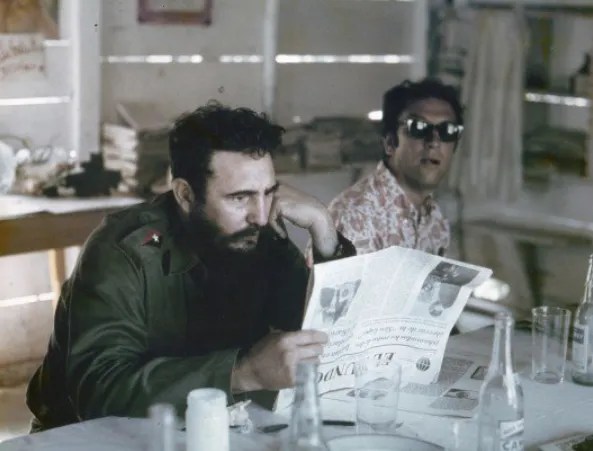
According to former Vice Minister of Foreign Relations and founder of the Communist Party of Cuba, Sanchez-Parodi, Kissinger (alleged soviet agent according Polish counterintelligence defector Colonel Michael Golienski)52 used the June 1975 Cuba trip of Americans Frank Mankiewicz and Landua to relay an unsigned message to Fidel regarding ending hostility between the two countries.53
IPS and Connections to the Soviet Union
IPS during the 80’s was connected to the Soviet Union via the Soviet Institute for the Study of the U.S.A. and Canada (ISKRAN). ISKRAN was founded in 1967 by Russian born Georgi Arbatov.54 Georgi’s father was a communist that participated in Lenin’s revolution and was successful for awhile until the purges happened under Stalin. Georgi’s father was imprisoned in the early 40’s perhaps because of his Jewish background, although the official charge was counterrevolutionary sabotage which was later appealed and after serving some time the case was overturned.55‘56 Georgi survived the political damage done to his father and was made advisor to the Central Committee of the Communist Party of the Soviet Union while working at ISKRAN.
Former KGB officer Stan Levchenko said of ISKRAN that it functions under the international department of the Central Committee of the Communist Party of the Soviet Union.57 Furthermore, its ideology department was run by KGB General Radomir Bogdanov who specialized in active measures and also part of that department was Russian military intelligence general Mikhail Milshtein who reportedly was transferred from the GRU to the Chief Directorate of Strategic Camouflage (GUSM).58
Luvchenko goes on to explain that:59
A large number of the Institute’s papers are used for purposes having little to do with scientific research. One of the many clients of the Institute is Service “A” (Active Measures) of the First Chief Directorate of the KGB, which plans and implements global and regional active measures with the approval of the Soviet Politburo. Almost every product of the Institute can be utilized for this. For instance, data on the activity of multinational corporations is used by the International Department A and the KGB to spread disinformation and forgeries in some of the Third World countries to plant seeds of suspicion towards their activities.
Levchenko makes it quite clear ISKRAN is a front for Soviet Intelligence and active measures against the West. With this in mind, it is troubling that IPS was collaborating with ISKRAN. For example, in April 1981 Marcus Raskin of IPS visited Moscow to meet with Arbatrov and Vadim Zagladin (the latter a perestroika theoretician who authored works such as The World Communist Movement: Outline of Strategy and Tactics).60‘61 Another meeting followed in 1983 between IPS and ISKRAN in Minneapolis which included participants Cora and Peter Weiss (Samuel Rubin Foundation) and Jerome Grossman of the Council for a Livable World.62 Again, there was subsequent meeting held in the Soviet Union in 1984,63 and in 1985 Raskin and IPS along with ISKRAN sponsored a private disarmament conference on September 5th in San Francisco with Arbatov.64
Conclusion
While TNI clearly had communist funding and directors, IPS seems to have flown under the radar more than TNI. However, from this short article we saw that IPS had communists as fellows and helped stand up and fund TNI whose first director was a communist. Furthermore, IPS was collaborating with at least one Soviet intelligence front organization.
Quoting U.S. House Representative Larry McDonald’s Congressional testimony at length, he said of IPS that:65
IPS is a consortium of Marxists pressing for revolutionary change in American domestic and foreign policies through a variety of tactics. However, the single cohesive cord that binds together IPS’s multitude of projects and activities is the influencing of U.S. policies along lines favorable to the interests of the Soviet Union, its satellites, client states and controlled terrorist national liberation movements. Those individuals who have quit the Soviet KGB, government and Communist Party posts to seek freedom in the West have emphasized that the Soviets place the greatest importance not on mere classical espionage, the collection of military, industrial, and political information; but on the recruitment and placement of what is termed “agents of influence. ”Individuals under their control who can influence the public via the press, the academic community, Congress and the executive branch.
Anticommunists and those that believe in upholding the foundations of Western civilization should, therefore, view IPS and TNI as hostile political enemies and track and scrutinize their actions while working to oppose them.
Additional Notes of Interest
- IPS and Council for a Livable World often appear together on letters to Congress.66
- Code Pink also appears on some of those letters and their co-founder Jodie Evans is on the board of Trustees for IPS.67‘68
- Seymore Hersh received an award from IPS.69 His articles are known to be anti-American. One of his latest ones was on the Nord Stream which got republished on InfoWars a news org deeply connected in the crypto-Marxist and crypto-communist ecosystem.
- The Nation is partly own Katrina vanden Heuvel who is also on the board of trustees for IPS. Her husband was Stephen F. Cohen (deceased) who was a co-founder in 1974 of the American Committee for East–West Accord which supported SALT.
- In the Senate congressional record of 1982, it is stated that the Committee for National Security was established by the Institute for Policy Studies.70 On a 1989 CNS memo Stephen Cohen was listed as member along with, Richard Barnet, Paul C. Warnke (former IPS trustee) and William E. Colby (former CIA director) among others.71
- The Senate record also stated that “The Zill report noted Warnke was working with ACEWA (Cohen’s group) on a task force to implement the Kennan proposals on nuclear weapons cuts.”
- Quoting an interview with Ukrainian-American historian Sergei Zhuk, he said: “Another international “venue of influence”, initiated by the former graduates from the Institute of the USA and Canada, and now by the active members of Russian intelligence, is the Valdai Discussion Club in Russia.72
- In 1971, Raskin received from Daniel Ellsberg, documents that became known as the Pentagon Papers. Raskin put Ellsberg in touch with New York Times reporter Neil Sheehan, whom Ellsberg had first met in Vietnam.
- Ellsberg was a member of Unity4Julian (a pro Assange group) along with a host of other pro-Russian people.
Citations
- Marcus Raskin, influential liberal think tank founder, dies at 83 (Dec 29, 2018), The Times of Israel, Eric Cortellessa, https://www.timesofisrael.com/marcus-raskin-influential-liberal-think-tank-founder-dies-at-83/ ↩︎
- Jame Raskin’s Wikipedia page, https://en.wikipedia.org/wiki/Jamie_Raskin ↩︎
- Duke Law Director, Sarah Bloom Raskin, https://law.duke.edu/fac/raskin ↩︎
- Council on Foreign Relations Membership Roster, https://web.archive.org/web/20240629130643/https://www.cfr.org/membership/roster ↩︎
- Richard Barnet’s Wikipedia entry, https://en.wikipedia.org/wiki/Richard_Barnet ↩︎
- Continuing the Inquiry Consensus Endangered, Council on Foreign Relations, https://web.archive.org/web/20170110131742/http://www.cfr.org/about/history/cfr/consensus_endangered.html ↩︎
- Institute for Policy Studies History Page, https://ips-dc.org/about/history/ ↩︎
- Institute for Policy Studies Part 01, FBI Vault, pp 80-81, https://vault.fbi.gov/institute-for-policy-studies/institute-for-policy-studies-part-01/view ↩︎
- Ibid. ↩︎
- A Casualty Of War and Then of Love (Oct 3, 2006), Washington Post, David Chanoff,
https://web.archive.org/web/20230305222112/https://www.washingtonpost.com/archive/lifestyle/2006/10/03/a-casualty-of-war-and-then-of-love/6e7a3d0f-bc45-4d09-a85f-a8566ae031ac/ ↩︎ - Marshall D. Sahlins, Groundbreaking Anthropologist, Dies at 90 (April 10, 2021), The New York Times, Clay Risen, https://web.archive.org/web/20210411014152/https://www.nytimes.com/2021/04/10/us/marshall-d-sahlins-dead.html ↩︎
- Marshall David Sahlins Obituary (Nov 7, 2021), AnthroSource (Published by the American Anthropological Society), https://archive.is/yvpel#selection-1151.0-1151.22 ↩︎
- Ibid. NYT. ↩︎
- Ibid. NYT. ↩︎
- Ibid. NYT. ↩︎
- https://archive.lib.msu.edu/DMC/AmRad/nationalvietnamexam.pdf ↩︎
- A Think Tank on the Left: The Institute for Policy Studies and Cold War America, 1963-1989 (August 2015), University of Wisconsin-Milwaukee, Brian Scott Mueller, pp. 49-51, https://dc.uwm.edu/cgi/viewcontent.cgi?article=2019&context=etd ↩︎
- SIGNERS OF 1939-40 COMMUNIST PARTY PETITIONS FOR
STATE AND CITY ELECTIONS, BOROUGHS OF NEW
YORK CITY, https://books.googleusercontent.com/books/content?req=AKW5QacBYHYEV9BlPq2Tm_w04gHMswcv2IU6MO2G0JNm541Nez9E5YwYaxYoopD5lMQaRmp-CXLfX4ATz8LKzAkxhK7sk8l94yXI0EjKoTbqMKML0ZChZIm9b-ATeww7pnANS-bN2Ht_J2dNnB-Jl3dcuRcVAOX36fgL7XbW5D3lw7sVw_ue-nICAHwsqKqdMock_sbm0UodKAByAIw5T3p5061hfkZ6H8wHffgEeLAHlyefXtXzmuaRMtUDx6h0M9wluN5DTTCkoERTsWASmgh1-DVOqRwTJflpjXjHK7AMYY6vtqscHaQ. Pg. 153 ↩︎ - Forty important, interesting and quirky facts about TNI (March 20, 2014), Transnational Institute, https://www.tni.org/en/article/forty-important-interesting-and-quirky-facts-about-tni , https://archive.is/gPszD ↩︎
- Institute for Policy Studies’ Influence on U.S. Foreign Policy (May 13, 1980), U.S. House of Representatives, Hon. Larry McDonald, https://www.govinfo.gov/content/pkg/GPO-CRECB-1980-pt9/pdf/GPO-CRECB-1980-pt9-3-3.pdf ↩︎
- Cora Weiss Papers, 1960- (archived June 13, 2018), Swarthmore College Peace Collection, https://web.archive.org/web/20180613200328/http://www.swarthmore.edu/Library/peace/DG201-225/dg222cweiss.htm ↩︎
- Ronald Reagan Presidential Library Digital Library Collections. Collection: DeGraffenreid, Kenneth E.; Files. Folder Title: Soviet “Active Measures” and the Freeze 09/01/1982-10/31/1982, https://www.reaganlibrary.gov/public/digitallibrary/smof/nscintelligence/degraffenreid/r27/40-139-39149351-R27-012-2019.pdf ↩︎
- 26SUBVERSIVE INVOLVEMENT IN THE ORIGIN, LEADERSHIP, AND ACTIVITIES OF THE NEW MOBILIZATION COMMITTEE TO END THE WAR IN VIETNAM AND ITS PREDECESSOR ORGANIZATIONS. Staff Study by the Committee on Internal Security (1970), U.S. House of Representatives, pg 51, footnote #52, https://fau.digital.flvc.org/islandora/object/fau%3A32474/datastream/OBJ/view/Subversive_involvement_in_the_origin__leadership__and_activities_of_the_New_Mobilization_Committee_to_End_the_War_in_Vietnam_and_its_predecessor_organizations___staff_study_by_the_Committee_on_Internal_Security__House_of_Representatives__Ninety-first_Cong.pdf
See also
COMMUNIST ACTIVITIES IN THE CHICAGO, ILLINOIS, AREA PART 1 (1965), Committee on Un-American Activities House of Representatives, https://dn790002.ca.archive.org/0/items/communistactivit651unit/communistactivit651unit.pdf ↩︎ - Transnational Institute History Page, https://www.tni.org/en/history , https://archive.is/RaNLA ↩︎
- https://en.wikipedia.org/wiki/Eqbal_Ahmad ↩︎
- https://www.dawn.com/news/1179332 ↩︎
- When Eqbal Ahmad was shot at in Kashmir (May 1, 2016) Scroll.in, Abir Bazaz, https://archive.is/EAR8Z ↩︎
- 19th World Festival of Youth and Students (Nov 2, 2017), https://www.hse.ru/en/ma/pd/news/211438349.html ↩︎
- Smokers’ Corner: Eqbal Ahmed: the astute alarmist (May 3, 2015) Dawn, Nadeem F. Paracha, https://www.dawn.com/news/1179332 ↩︎
- Eqbal Ahmad, Center for Public Education, https://eacpe.org/about-eqbal-ahmad/ ↩︎
- Fanon’s Wikipedia entry, https://en.wikipedia.org/wiki/Frantz_Fanon ↩︎
- Algeria honours Eqbal Ahmad (July 15, 2023), Dawn, Pervez Hoodbhot, https://www.dawn.com/news/1764778 ↩︎
- Ibid. ↩︎
- How the founder of Black Lives Matter started a global movement (April 5, 2018), Dazed, Rianna Walcott, https://web.archive.org/web/20200616050344/https://www.dazeddigital.com/politics/article/39587/1/black-lives-matter-founder-interview-patrisse-khan-cullors ↩︎
- The Antinomies of Aijaz Ahmad (1941 – 2022): From Ghalib to Gramsci (April 1, 2022), The Friday Times, Raza Naeem, https://thefridaytimes.com/01-Apr-2022/the-antinomies-of-aijaz-ahmad-1941-2022-from-ghalib-to-gramsci ↩︎
- Eqbal Ahmad, Center for Public Education, https://eacpe.org/about-eqbal-ahmad/ ↩︎
- SIGNERS OF 1939-40 COMMUNIST PARTY PETITIONS FOR
STATE AND CITY ELECTIONS, BOROUGHS OF NEW
YORK CITY, https://books.googleusercontent.com/books/content?req=AKW5QacBYHYEV9BlPq2Tm_w04gHMswcv2IU6MO2G0JNm541Nez9E5YwYaxYoopD5lMQaRmp-CXLfX4ATz8LKzAkxhK7sk8l94yXI0EjKoTbqMKML0ZChZIm9b-ATeww7pnANS-bN2Ht_J2dNnB-Jl3dcuRcVAOX36fgL7XbW5D3lw7sVw_ue-nICAHwsqKqdMock_sbm0UodKAByAIw5T3p5061hfkZ6H8wHffgEeLAHlyefXtXzmuaRMtUDx6h0M9wluN5DTTCkoERTsWASmgh1-DVOqRwTJflpjXjHK7AMYY6vtqscHaQ. Pg. 153 ↩︎ - When Eqbal Ahmad was shot at in Kashmir (May 1, 2016), Scroll, Abir Bazaz, https://scroll.in/article/806458/when-eqbal-ahmad-was-shot-at-in-kashmir ↩︎
- A Civilizing Mission (Nov 27, 2006), The Nation, Amitava Kumar, https://www.thenation.com/article/archive/civilizing-mission/ ↩︎
- Transnational Institute Timeline, https://www.tni.org/files/styles/full_width_wide/public/timeline_0.png?itok=JpmKrCs7 ↩︎
- Milibrand’s Wikipedia bio, https://en.wikipedia.org/wiki/Ralph_Miliband ↩︎
- Gunder’s Wikipedia bio, https://en.wikipedia.org/wiki/Andre_Gunder_Frank ↩︎
- Marcuse’s Wikipedia bio, https://en.wikipedia.org/wiki/Herbert_Marcuse ↩︎
- Galtung’s Wikipedia bio, https://en.wikipedia.org/wiki/Johan_Galtung ↩︎
- A New International Economic Order from Below (May 1, 2024), Transnational Institute, https://archive.is/pOZyA ↩︎
- Remember Saul Landau (Sept 18, 2013) Other Words, Farrah Hassen, https://archive.is/9mbAp ↩︎
- Letelier-Moffitt Assassination: State Department Officials Pushed for Pinochet’s Ouster (Sept 20, 2019) George Washington University National Security Archive, https://nsarchive.gwu.edu/briefing-book/chile/2019-09-20/letelier-moffitt-assassination-state-department-officials-pushed-pinochets-ouster ↩︎
- Big Media Reporters Cover Up Evidence of Letelier as Cuban Agent (Oct 7, 1980), Washington Weekly, Reed Irvine, https://www.cia.gov/readingroom/docs/CIA-RDP90-00552R000403680042-6.pdf ↩︎
- The Epigone’s Embrace, Part II: C. Wright Mills and the New Left (Fall/Winter 2008), Left History, John H. Summers, pg. 109, https://lh.journals.yorku.ca/index.php/lh/article/download/24773/22992/ ↩︎
- Saul Landau, Maker of Films With Leftist Edge, Dies at 77 (Sept 11, 2013) The New York Times, Douglas Martin, https://web.archive.org/web/20130912171232/https://www.nytimes.com/2013/09/12/arts/saul-landau-maker-of-films-with-leftist-edge-dies-at-77.html ↩︎
- David Horowitz Interview (June, 1986) California Review, pg. 9 https://library.ucsd.edu/dc/object/bb71683667/_1.pdf ↩︎
- Is Kissinger a Soviet Agent? (Summer 1974) Frank A. Capell, https://www.cia.gov/readingroom/docs/CIA-RDP75-00149R000300140001-6.pdf ↩︎
- US-Cuba: The Challenge Posed by a New Relationship (Aug 20, 2015) Havana Times, Blanche Petrich, https://havanatimes.org/interviews/us-cuba-the-challenge-posed-by-a-new-relationship/ ↩︎
- https://en.wikipedia.org/wiki/Institute_for_US_and_Canadian_Studies ↩︎
- Georgi Arbatov obituary (Oct 18, 2010), The Guardian, Paul Lewis, https://www.theguardian.com/world/2010/oct/18/georgi-arbatov-obituary ↩︎
- The System: An Insider’s Life in Soviet Politics (1992), Georgi Arbatov, pp. 11-13 ↩︎
- Unmasking Moscow’s “Institute of the U.S.A.” (Dec 17, 1982), The Heritage Foundation, Stan Levchenko, https://www.reaganlibrary.gov/public/digitallibrary/smof/nscintelligence/degraffenreid/r26/40-139-39149351-R26-061-2018.pdf ↩︎
- Spetsnaz: The Story of the Soviet SAS, Viktor Suvorov, Chapter 13 ↩︎
- Ibid. ↩︎
- Ibid. ↩︎
- The World Communist Movement: Outline of Strategy and Tactics (1973), V.V. Zagladin, https://ia802305.us.archive.org/27/items/worldcommunistmovement1973/worldcommunistmovement1973.pdf ↩︎
- A Think Tank on the Left: The Institute for Policy Studies and Cold War America, 1963-1989 (August 2015), p. 301, University of Wisconsin-Milwaukee, Brian Scott Mueller, https://dc.uwm.edu/cgi/viewcontent.cgi?article=2019&context=etd ↩︎
- Ibid. pg 301 ↩︎
- Soviet Party Officials Claims Relations with U.S. Perilous (Sept 5, 1985), Washington Times, Bill Gertz, https://www.cia.gov/readingroom/docs/CIA-RDP90-00806R000100510001-3.pdf ↩︎
- INSTITUTE FOR POLICY STUDIES’ INFLUENCE ON U.S. FOREIGN POLICY (May 13, 1980), U.S. House of Representatives, Larry McDonald, 11103, https://www.govinfo.gov/content/pkg/GPO-CRECB-1980-pt9/pdf/GPO-CRECB-1980-pt9-3-3.pdf ↩︎
- Council Joins Organizations Across Political Spectrum to Decry Increasing Pentagon Spending Caps (April 9, 2019) Council for a Livable World, https://livableworld.org/council-joins-organizations-across-political-spectrum-to-decry-increasing-pentagon-spending-caps/ ↩︎
- Council signs onto letter expressing alarm at lack of DoD budget transparency (April 7, 2020), Council for a Livable World, https://livableworld.org/council-signs-onto-letter-expressing-alarm-at-lack-of-dod-budget-transparency/ ↩︎
- https://web.archive.org/web/20170617192104/https://ips-dc.org/about/staff-and-board/ ↩︎
- https://ips-dc.org/about/letelier-moffitt-human-rights-awards/ ↩︎
- Ronald Reagan Presidential Library Digital Library Collections. Collection: DeGraffenreid, Kenneth E.; Files. Folder Title: Soviet “Active Measures” and the Freeze 09/01/1982-10/31/1982, S12509 https://www.reaganlibrary.gov/public/digitallibrary/smof/nscintelligence/degraffenreid/r27/40-139-39149351-R27-012-2019.pdf S12509 ↩︎
- https://iiif.library.cmu.edu/file/Heinz_box00112_fld00012_bdl0052_doc0001/Heinz_box00112_fld00012_bdl0052_doc0001.pdf ↩︎
- https://ukrainianjewishencounter.org/en/sergei-zhuk-we-should-publicly-name-those-individuals-who-are-falsifying-history/ ↩︎
 S OF THE REPUBLIC
You must be logged in to post a comment.