By James A. Fulk (11.7.2025)
While I am typing these very words, a war of words is happening on X (formerly known as Twitter) with the most recent battle in the war sparked by both Nick Fuentes’s appearance and his comments on Tucker Carlson’s show. Fuentes previously expressed favorable pro-Nazi, pro-Hitler views as well as saying on Tucker’s show he is a fan of the deceased Communist leader of the Soviet Union Joseph Stalin. Both Hitler and Stalin were totalitarian rulers and both mass murdered Jews and Tucker, by having Nick Fuentes on and giving him a platform, pissed many people off especially because Tucker provided little pushback against Fuentes in the interview. To say there is something wrong with Nick Fuentes and his favorable views towards Hitler and Stalin is stating the obvious to normal thinking people. We need to understand the bigger problem, though, which is the amount of people that adhere to views similar to his and foreign powers such as Russia that promote his position to destabilize the United States in the hopes of also weakening support for Israel.
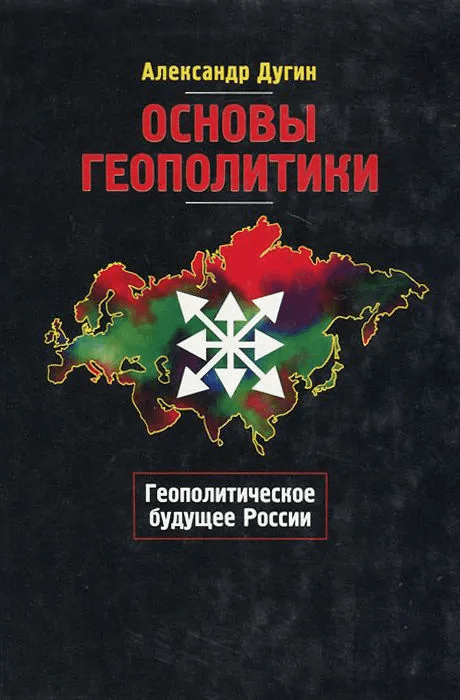
Published in 1997, Aleksandr Dugin’s book called the Foundation of Geopolitics (reportedly assigned reading for Russian military officers) called for:
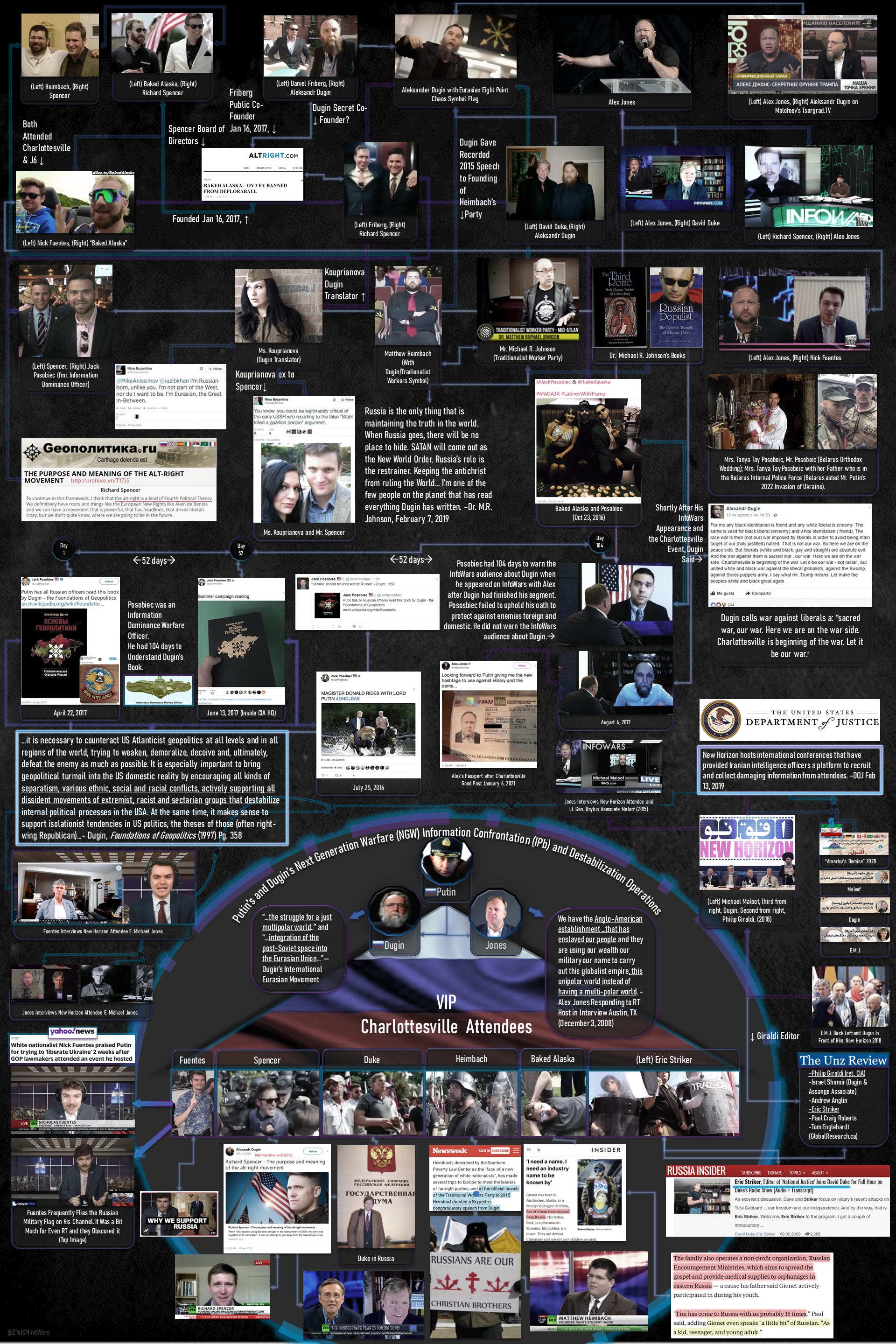
counteract[ing] US Atlanticist geopolitics at all levels and in all regions of the world, trying to weaken, demoralize, deceive and, ultimately, defeat the enemy as much as possible. It is especially important to bring geopolitical turmoil into the US domestic reality by encouraging all kinds of separatism, various ethnic, social and racial conflicts, actively supporting all dissident movements of extremist, racist and sectarian groups that destabilize internal political processes in the USA.
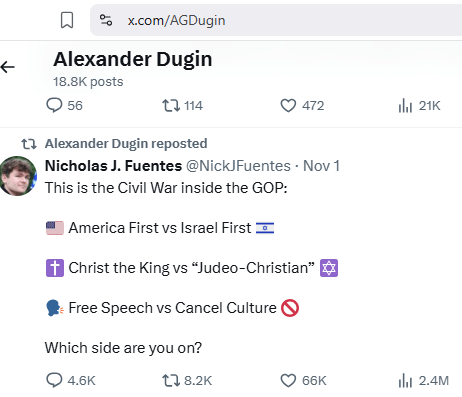
Breaking the United States from within is a strategy Russia employs in the hopes of obtaining its geopolitical objectives. Dugin, in alignment with what he wrote in 1997, recently reposted Fuentes on his X account. Fuentes is known to fly the Russian military flag on his video broadcasts, he appeared on Russian television before, and he was one of the more prominent people in alternative media that was at the riot in Charlottesville which included others that had pro-Russian views and were linked to Dugin as well as Alex Jones.
What are Russia’s objectives in the Middle East? I don’t pretend to be an expert on this and will only draw the reader’s attention to a few things that Aleksandr Dugin wrote in 1997 as well as some of what American diplomat Ira Hirschmann wrote in 1971.
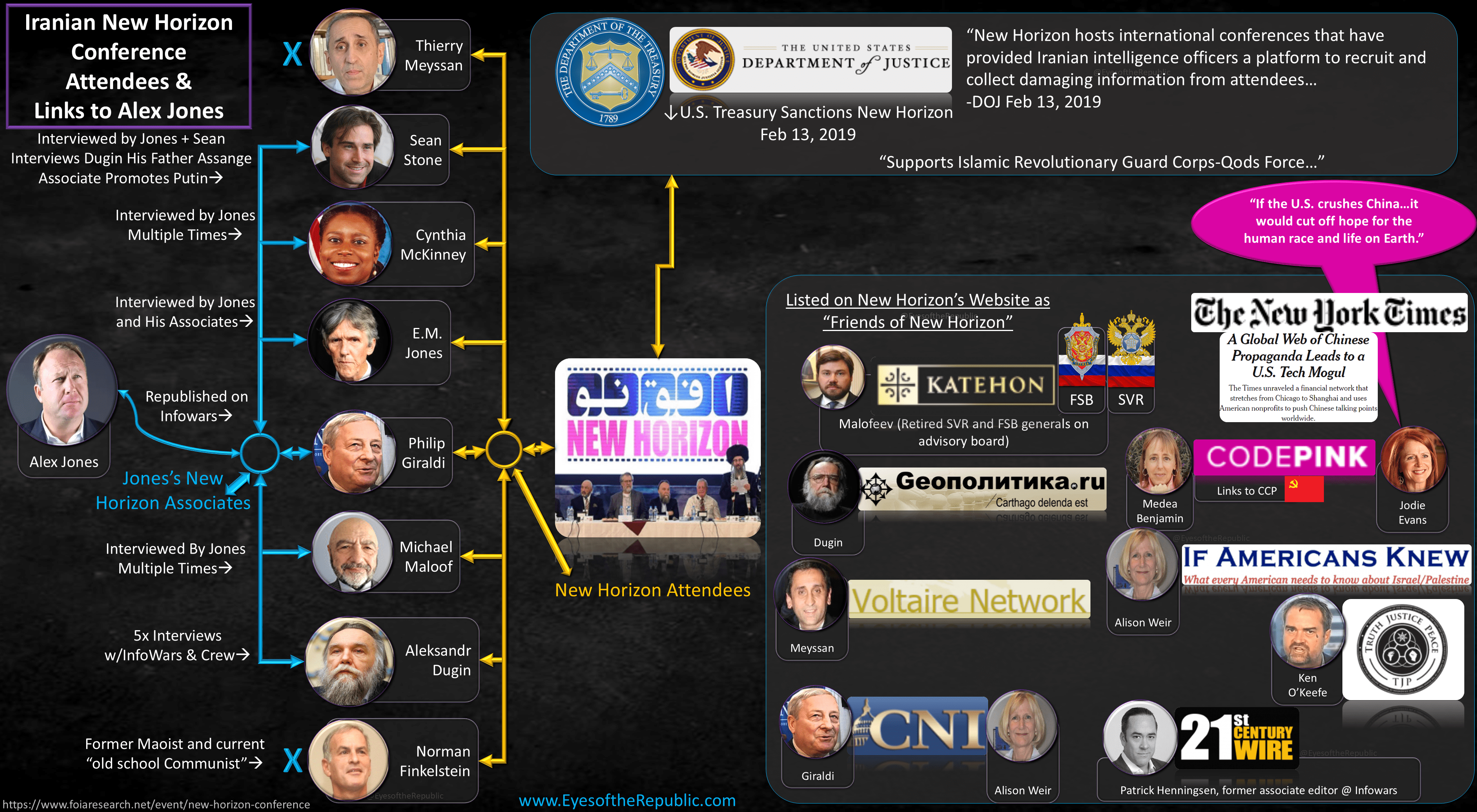
In Dugin’s Foundation of Geopolitics, he discusses the longtime desire and drive by Russia to gain access to warm water ports. As part of the strategy, he proposes an axis between Moscow and Tehran, and elsewhere he brought up that a union was proposed to Tehran, but the proposal was not taken seriously by either side. Obviously, for anyone following the news, Iran considers Israel a primary enemy, and, in supporting Iran, Russia is taking a position against Israel. Multiple individuals connected to Alex Jones (one of the biggest conduits in the world for Russian active measures and white propaganda to English speakers and readers), including Dugin, traveled to Tehran for the New Horizon Conference which came under U.S. Treasury sanctions for serving as a recruiting venue for Iranian intelligence. The conference represented a loose grouping of individuals across the world that were against the foreign policy of the United States and against Israel. Dugin’s attendance can arguably be explained by what he wrote in ’97 about trying to establish an axis between Moscow and Tehran which would put Russia at odds with Israel.
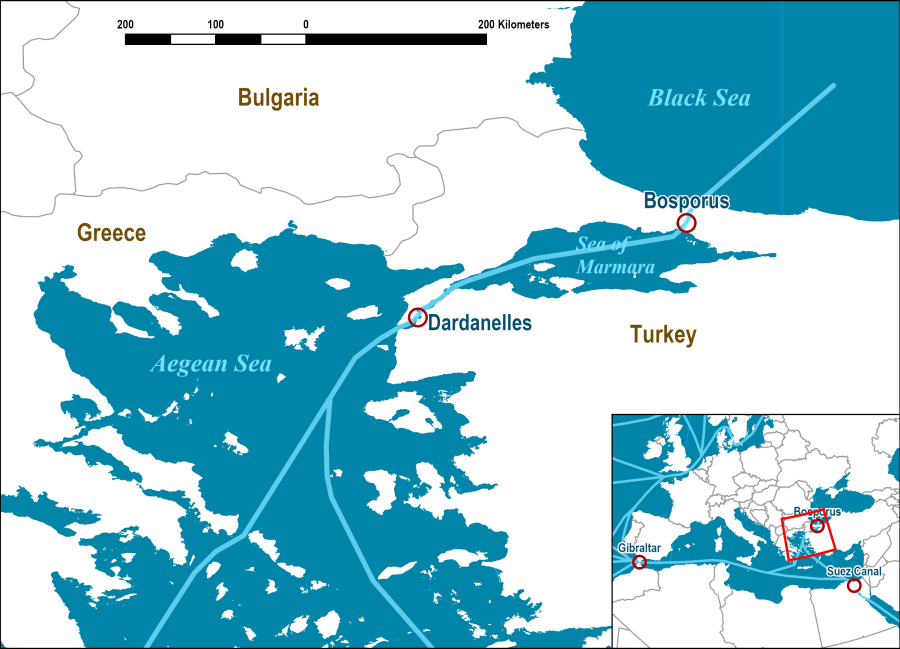
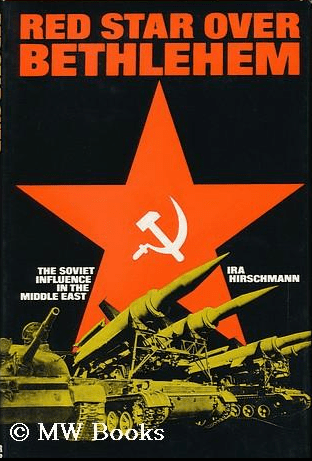
In Ira Hirschmann’s 1971 book titled Red Star over Bethlehem: Russia Drives to Capture the Middle East, Hirschmann explains to his readers that Imperial Russia wished to capture Constantinople, and it had a secret pact with the allies of WWI to have control of that city. If Russia had succeeded in this, it would have been in a position to control both the warm water Dardanelles and the Bosporus straights granting its black sea fleet unrestricted and worry free access between that sea and the Mediterranean without having to bother with the Ottomans in between. In 2025, Turkey, a NATO member, now controls what was Constantinople along with the Dardanelles and the Bosporus, and it is unlikely that Russia in the foreseeable future would be able to capture what is now Istanbul.
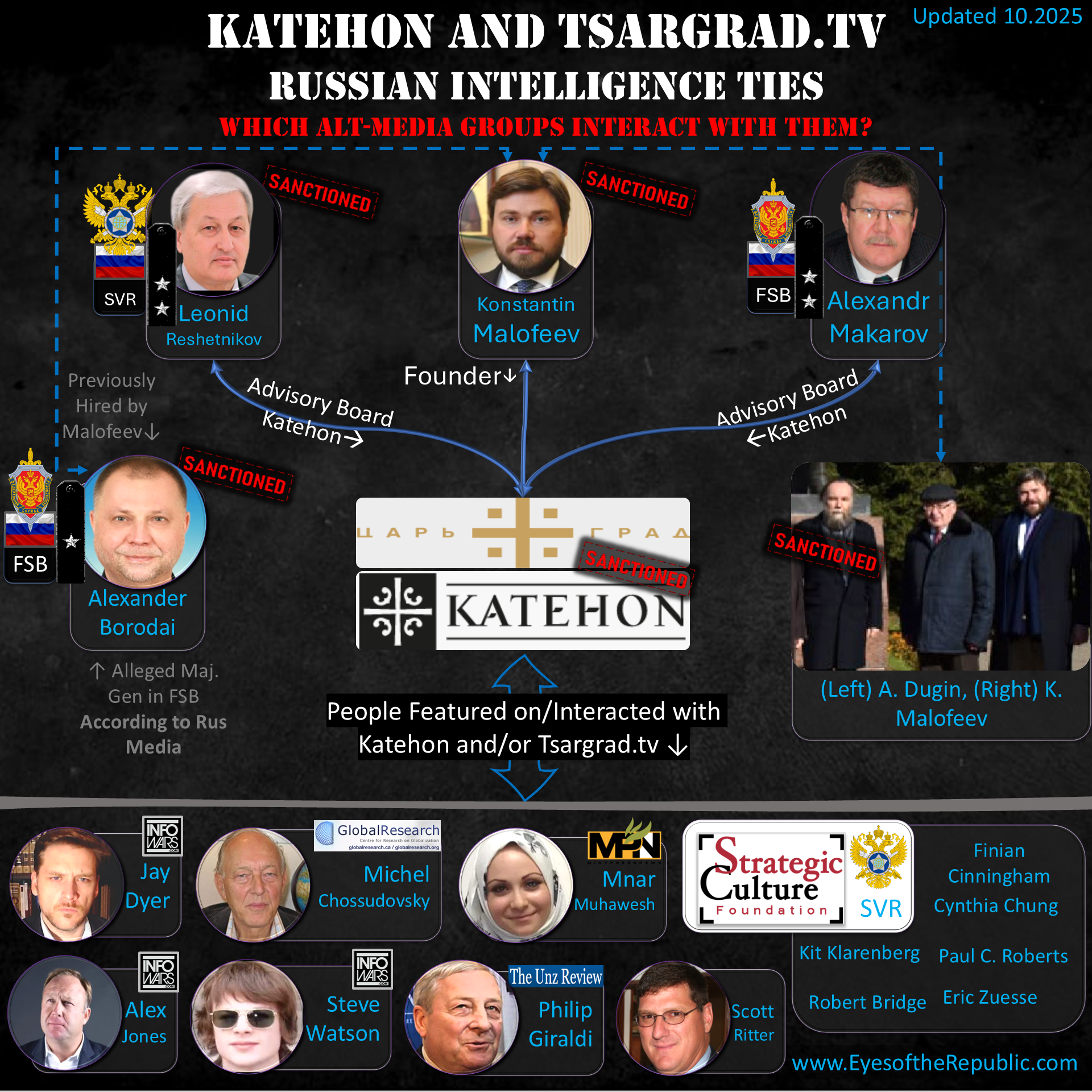
Speaking of Constantinople (capital city of the eastern and now long gone Roman Empire), Russia’s claim to being the Third Rome (see the marriage of Byzantian Zoe Palaiologina and Russian Ivan III) is promoted in circles such as those around Konstantin Malofeev who is a close associate of Dugin. The Third Rome claim helps Russia gain influence over Christians and might figure into a possible three state solution in Israel which Steve Bannon recently proposed. It should be noted that Steve Bannon pitched a U.S.-Russia alliance of sorts to Dugin in 2018 while in Rome (the alliance would be against China which is currently Russia’s military ally). Alex Jones, who is connected to Bannon and Dugin, suggested a U.S.-Russia alliance would be common sense (Alex Jones had Nick Fuentes on his program a dozen or so times). These are just two of the men with both media influence and influence inside of MAGA that are pushing Americans towards closer cooperation with Russia.
To see how Russia could leverage the Third Rome claim and position itself as a protector of Christians in the middle east based on prior foreign policy maneuvers, I will turn to an example that Hirschmann mentions in his book. HIrschmann said that:
Czar Nicholas I…demanded from Sultan Abdul Medjid of Turkey not merely the guardianship of the Holy Places, but also a protectorate over all Orthodox Catholics in the Sultan’s dominions—a concession that would have reduced Turkey to Russian vassalage.
The Sultan didn’t submit to the Czar’s demands. Russia could potentially make a similar play today by continuing to destabilize the Middle East through its proxies which threaten Israel, and if Israel was weakened enough by future attacks along with a turn in public opinion in the United States while Russia and the U.S. draw closer together, Russia could join with the United States pushing for a three state solution and lobby to get its forces in the region (they are already to the north in Syria) under the pretense of being peace keepers and helping to protect Christians. This might seem like a long shot, but I wouldn’t put it past the Russians to have war gamed this as a future, possible scenario.
Many years later after the Czar’s proposal to the Sultan, in the 1950’s, as Britain was winding down in the Middle East, the Soviet Union was trying to move in to the Middle East to fill the vacuum. It had already concluded neutrality treaties with Turkey, Iran and Yemen. It voted in favor of the UN partition plan for Palestine in ’47 and in ’48 it recognized the state of Israel. The Soviet Union’s decisions were motivated by what would weaken British and Western influence in the region.
After Israel came into existence, Hirschmann informs his readers that the secretary general of the Arab League, Azzam Pasha, “told a press conference in Cairo that the aim of the Arabs was the ‘extermination and momentous massacre’ of the Jews.” The Arabs were not happy about the formation of Israel and wanted to wipe them off the map, while Russia wanted Israel as a proxy in the region and was putting its chips on that possibility until 1952 which is when Hischmann said they had swung to the Arab side.
According to Hirschmann, the Soviets were expecting that the “liberal orientation of Israel and the social philosophy of the Kibbutz movement would ensure Israel’s support of the Soviet Union.” But Stalin wasn’t going to gain control over Israel by poor treatment of Jews in his own country. Writing for the publication Commentary in 1974, Soviet dissident historian Lev Navrozov brought to the attention of the world the fact that Stalin had asked Israeli ambassador to the Soviet Union, Golda Meir, in 1948-49 to “draw up a list of all those Soviet Jews who wished to volunteer to serve in the Israeli War of Independence.” Expecting Stalin’s help, Meir complied and the result was devasting. Stalin turned the list over to his secret police and arrests followed with Soviet Jews that were to be freedom fighters for Israel were instead sent off to “concentration camps for extermination by hunger, labor, and frost.” Israel surely learned a painful lesson from Stalin’s actions, and it wouldn’t be the last painful one it would learn from professed friends.
When Soviet support had swung to the Arab side a few years later, Moscow began arming Egypt and Egypt started training and equipping the Fedayeen which was constituted by Palestinian refugees whose goal was the destruction of Israel. Decades of Soviet and later Russian arming and funding groups opposed to Israel ensued.
Between Hirschmann’s writings in 1971 and when Dugin’s picked up in 1997, there is much more to discuss in regards to Russia’s strategy in the Mideast, but these notes I have typed out here serve as a starting point for future readings and writings that I hope to pursue on this complex subject.
 S OF THE REPUBLIC
You must be logged in to post a comment.